Victorian Catteshall, 1837-1901
Catteshall Lane has several important industrial sites, most of them pre-dating but still operating in, Victorian times. At the town end was the Godalming Wharf, where the barges on the Navigation loaded and unloaded and goods were stored. The Wey had been made navigable from Guildford to the Town Bridge in Godalming in 1764. At first the main cargo was timber, brought in by road to Godalming from the forests of Surrey, Sussex and Hampshire and carried downstream to the London shipyards. Gunpowder was also carried on the Navigation. It was brought by waggon from the mills at Chilworth and loaded onto barges at Stonebridge Wharf at Shalford.
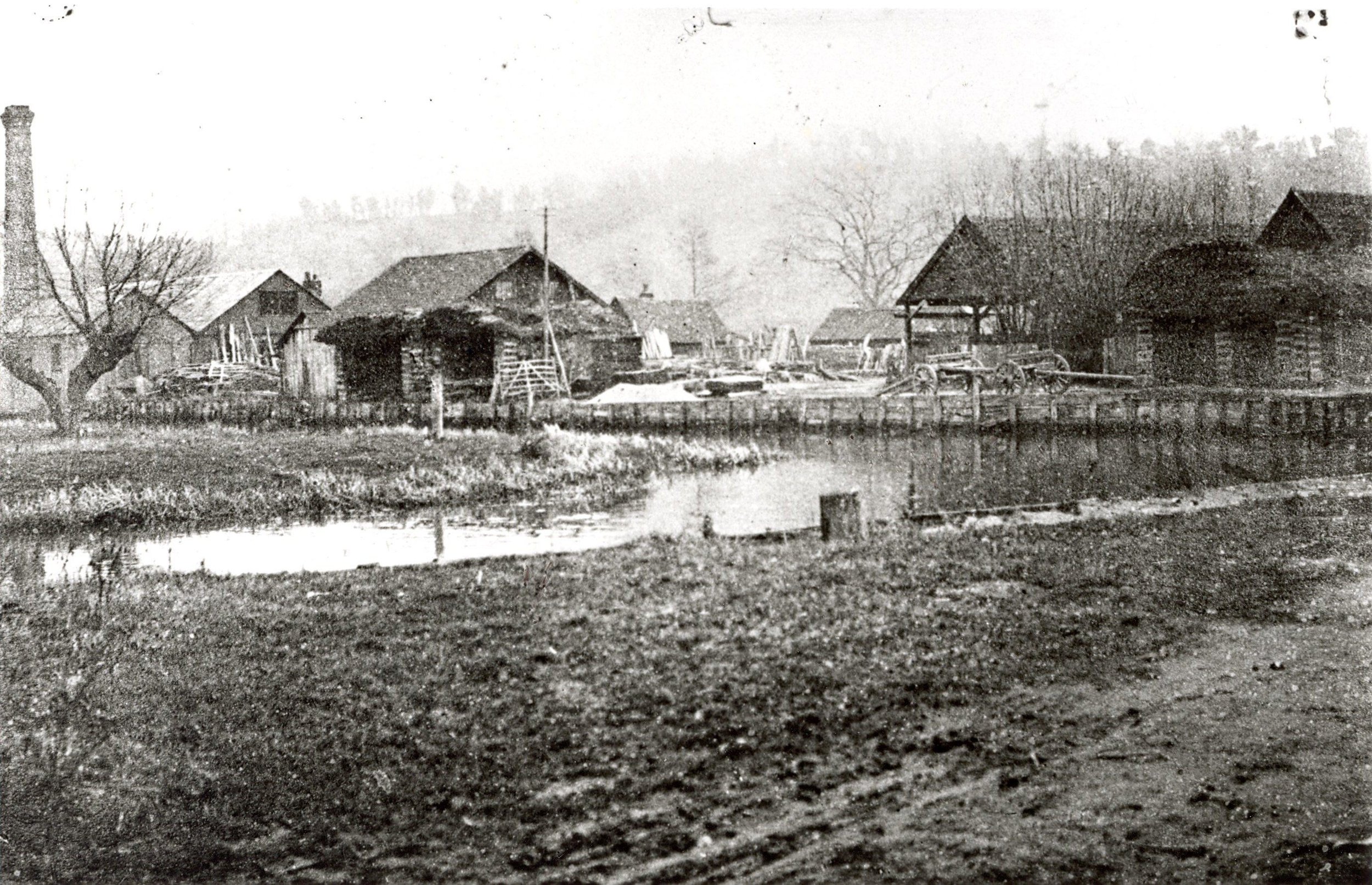
Photographic print of postcard showing Marshall's timber yard at the Wharf
The Godalming Wharf covered a large area, stretching from the Navigation, up the hill to Catteshall Lane. It was managed by the Commissioners for the Godalming Navigation. George Marshall, who was appointed as one of the Commissioners in 1817, lived in Bridge House, between the Wharf and the Town Bridge (where the Probation Office is now). A survey of 1830 recorded that he owned 5 barges – Hope, London, Royal Oak, Triumph and Wey, carrying corn, firewood, groceries, oil cake and timber. A plan of the Wharf at this time shows warehouses for groceries, flour, bark (oak bark for tanning), coal and coke. But by the mid 19th century the main traffic on the Navigation was upstream - bringing softwood, bricks and slates for new buildings in the town, coal for homes and for the Gas Works and rags and esparto grass for the paper mill at Catteshall.
The Navigation became less profitable as the roads improved, and especially after the railway reached the town in 1849, and the Wharf began to shrink. Part of it had been sold to the Godalming Gas and Coke Company, to build the gas works in 1836, more was let for grazing. Local Historian Charles Softley (1829 - 1916) remembered the gas works being built; “The writer saw the digging out for the gasometer, as also the laying of pipes to the town and shops, remembering the great excitement at the first lighting up therein, and the changing of oil lamps for gas ones.”
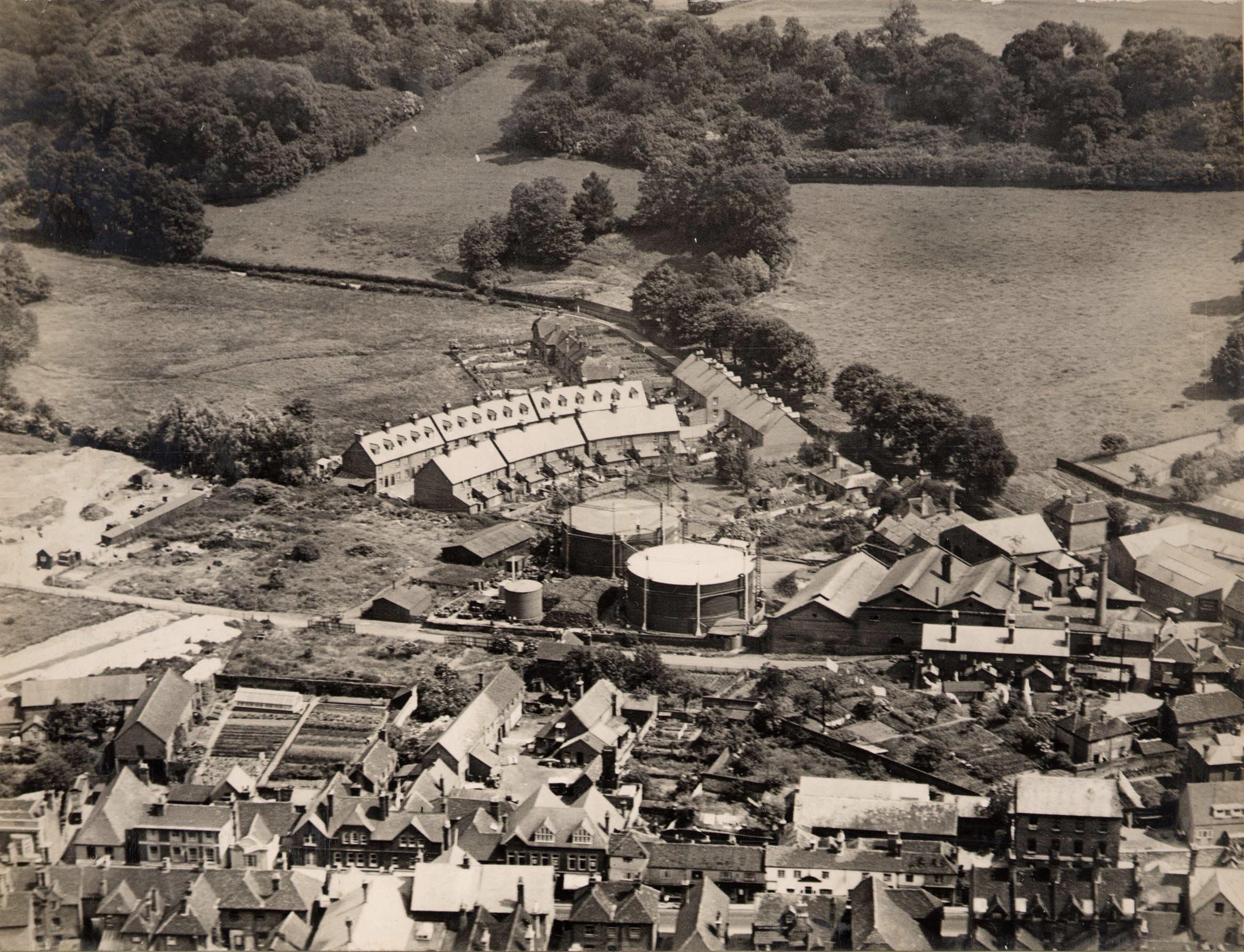
Aerial photograph of Godalming in 1936 showing the Gas Works in Catteshall Road and Victoria Road.
On the 1871 map below, you can see the gas works at the top of Catteshall Lane. Across the corner of the Lane and the Wharf the Godalming Voluntary Fire Brigade had built a new fire station in 1870, although it is not marked on this map. Next came Spring Place, a row of cottages, some of which survive to this day. Catteshall Lane at this time was narrow and in poor condition. Charles Softley wrote about the spring, which is marked on the map opposite the cottages, “The Spring at this time running across the road, made it at times almost impassable, inundated and muddy.”

Next on the lane on the 1871 map is the Langham Hosiery Factory. Softley recorded that this had previously been a “Dyehouse by Mr Oliver” – “It was but a small affair and was soon made into a Manufactury for the woollen trade by Mr Holland, who removed to it from the ‘Lobby’ on the Wharf.” The Holland family had patented their fleecy hosiery in 1788 and moved to Godalming in 1790. The local framework knitting industry was in decline at the beginning of Queen Victoria’s reign but Holland’s fleecy hosiery, patent against gout and ideal for explorers, continued to sell. The company exhibited at the Great Exhibition in 1851. The Langham factory was taken over by the Nevill family in the 1850s. Above the factory was a pond, fed by a spring which was said to be the finest water in the area for processing wool. When Alan and Solly built their factory in Mill Lane in 1873, right by the Ock, they carted water in from the Langham spring.

Pair of fleecy and Segovia socks made by George Holland. George Holland of London patented his fleecy and Segovia hosiery in 1788 and set up a factory in Godalming in 1790. His socks were said to be excellent for sufferers from gout and rheumatism and examples were shown at the Great Exhibition of 1851.
Beyond the Langham Factory the condition of Catteshall Lane worsened. Charles Softley described how “the road to Catshall onward was impassable for pedestrians, a raised path to the right taking us out at its end, near to the Ram and so to Catshall.” In a poem describing the area as he remembered it as a boy he wrote of “rough straggling footways, dark untrodden paths” and “weird, uncanny dwellings.” The path led on to what had been a farm, belonging to the More Molyneux family of Loseley House and farmed by Mr Stovold. Conditions at this end of the Lane improved when George Marshall bought the farm and turned it into a rather grand gentleman’s residence, renaming it Catteshall Manor. Charles Softley thoroughly approved: -
“Now, long the well-made road we pass the Ram
Sending pellucid waters with a thud
To distant Munstead, from the purling springs
Where once no foot might tread for thickest mud.
Now home we reached the neat and pleasant lodge
Where dwell all kindly hearts we call upon
Whence trees, and shrubs, and grassy slope, and path
Leading romantic-like down to the pond …
See where the open space divides the trees
The Manor-house just peering out to view
Deep set in foliage of dark and green
And other beauties various in hue
O Stovold! Couldst thou now but take review
See where thy teeming flocks, thy milching kine
Thy fruitful fields, thy growing crops, thy home,
What latent memories waken in thy mind.”
‘The Ram’ Softley mentioned is a hydraulic ram - a gravity pump. It is marked on the 1871 map and there is still a pump there today, behind a door with a glass front in the bank, although this is a 1920s replacement, installed by John Blake Ltd of Accrington. Between the Manor and the Navigation lay the Catteshall Mill complex, the largest in the town, and dating back at least to the time of the Domesday Book (1086). It began as a corn mill and operated as one for eight centuries. In around 1360 a fulling mill was built alongside the corn mill. By 1661, perhaps in response to the decline in the woollen industry, this had become a paper mill. From the early 19th century, there was also a tannery on the site, run by the Twycross family. The Paper Mill at this time was run by the Quaker Sweetapples. Charles Softley says that Thomas Sweetapple built the row of cottages leading to the Ram. The 1841 census lists ten paper-mill workers living in Catteshall and more in Farncombe and Meadrow.
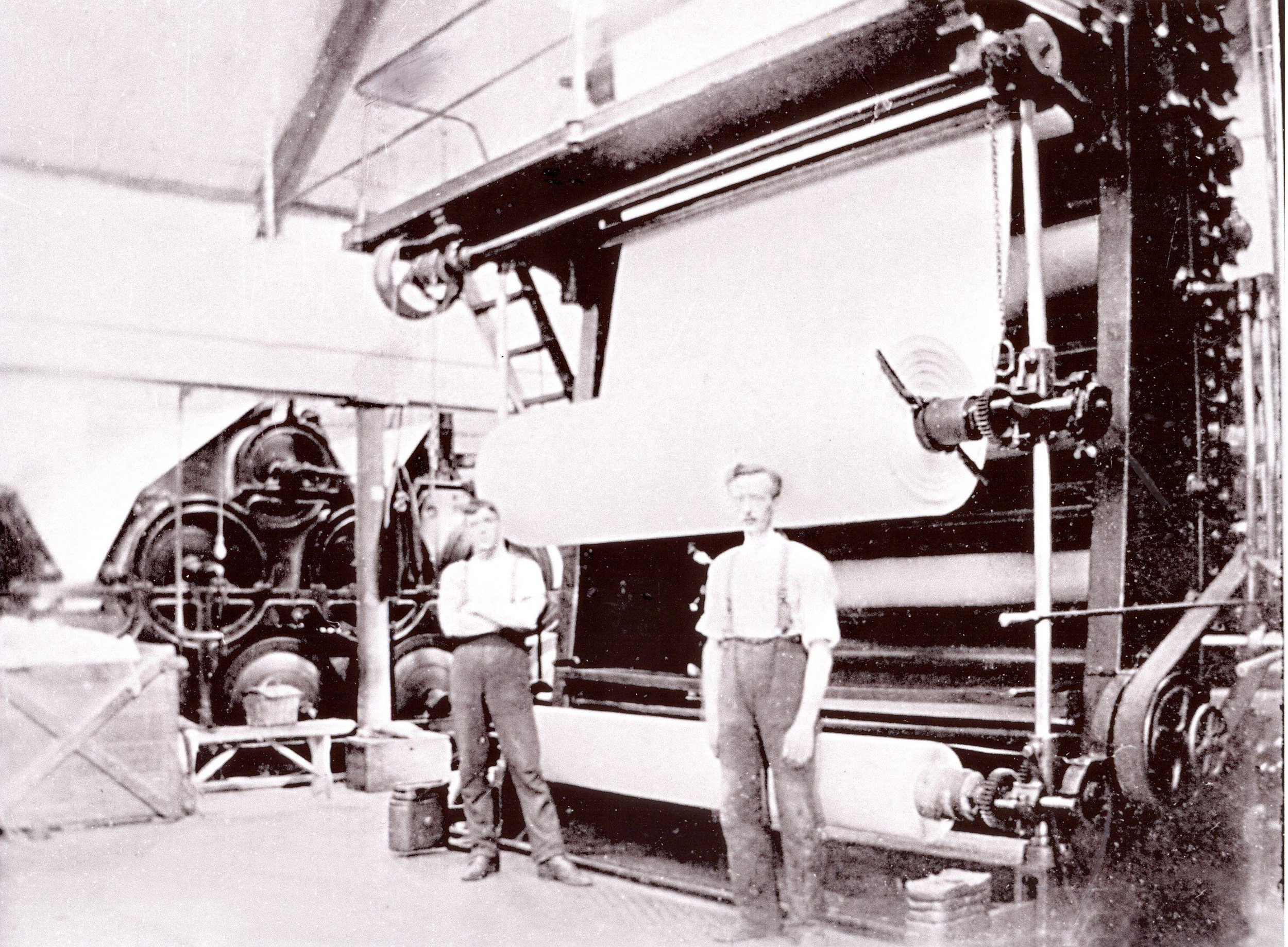
Photograph of Jim Mandevill, a labourer at Catteshall Paper Mill, standing in front of a machine which is producing a large roll of paper.
In 1868 the Spicer Brothers took over the mill. They installed a new turbine, which was only removed in 1981, when it was rescued by the Godalming Water Turbine Trust. It is now at the Ironbridge Museum in Shropshire. The Spicers expanded the mill, applying for permission to move the high road to accommodate their new buildings. They introduced the use of esparto grass, although they also used the traditional rags. Herbert Spicer and his family lived opposite the mill at the Mill House (later the Grange). He was a Congregationalist and a supporter of the temperance movement, and built the Coffee Tavern and Mission Hall at the corner of Catteshall Lane and Meadrow (now Sweetapple House and the Godalming Naval Club).
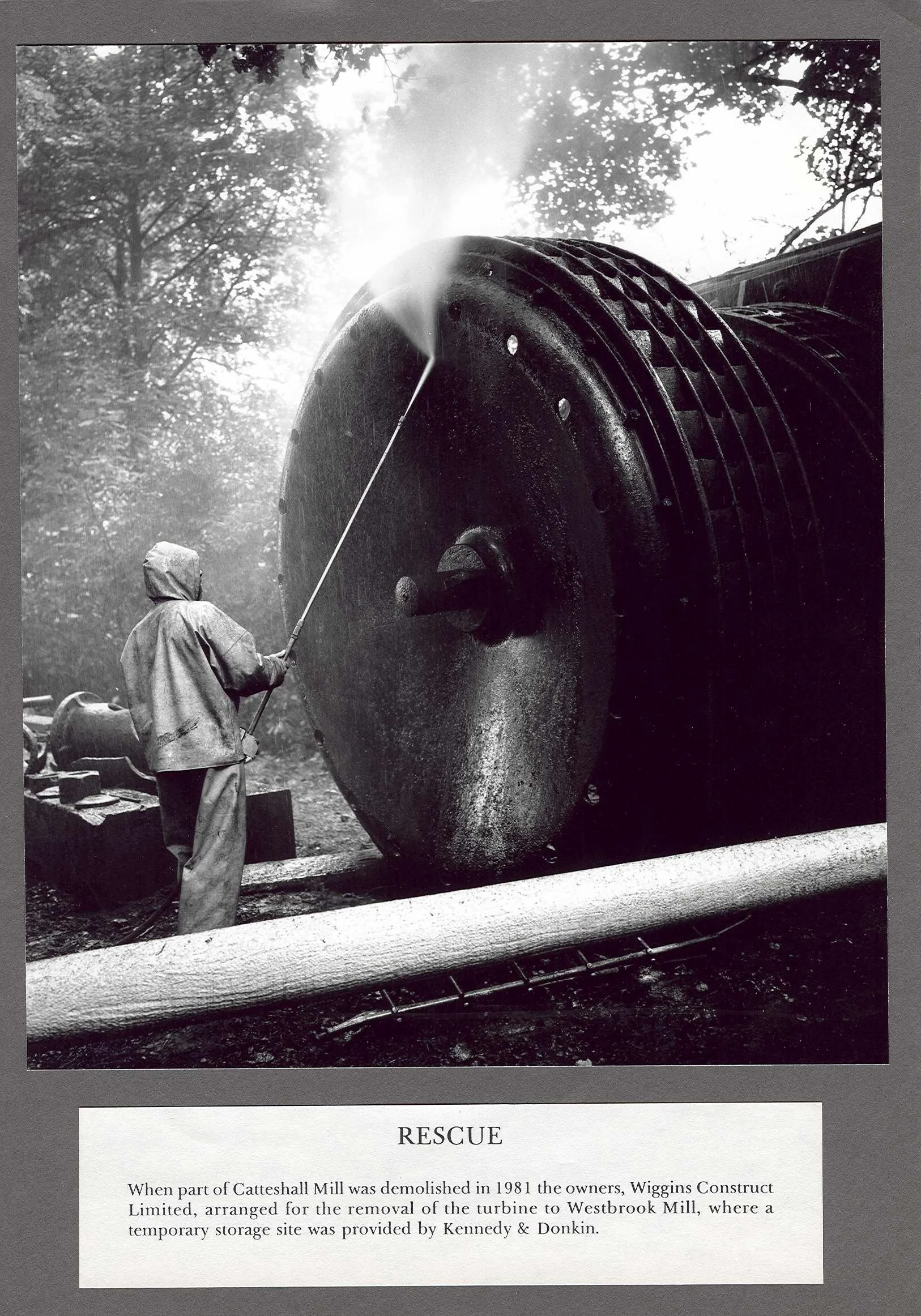
Photograph of the turbine from Catteshall Mill being cleaned in 1982 prior to its removal to Westbrook Mill, for temporary storage .
On 23 December 1883 one of the esparto grass pressure boilers at the mill exploded, scalding nine people, five of whom died the following day. The report on the accident states that over 400 people were working at the mill at this time. Sewage from the Mill was also a concern. In 1887 the Guildford Rural Sanitary Authority instigated proceedings against the Spicer Brothers and they were required to build two settling tanks to hold 140,000 gallons each and to discharge into the sewers of the Drainage Board or into their own filter beds. Towards the end of the 19th century the mill went into decline. It was briefly closed in 1898, by which time only 150 people were working there. A new company, the Farncombe Paper Company, was formed, and the mill began operating again in the early 20th century.
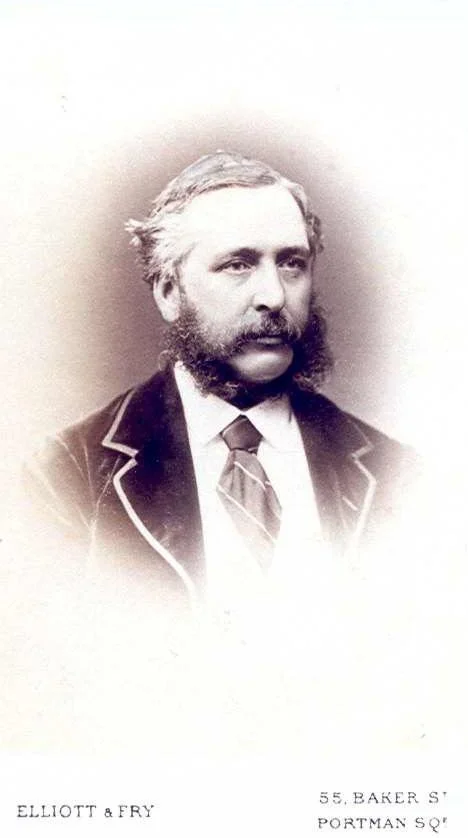
Photograph of Herbert Spicer, (1849-1916) owner Catteshall Paper Mill. Photograph by Elliott & Fry. Mr Spicer died 12th May 1916 after being hit by a train on Rye House Railway Station.
The 1897 map below includes Victoria Place and Road at the town end of Catteshall Lane, built in 1887, the year of Queen Victoria’s Golden Jubilee. They were described in the Godalming Magazine for July 1888. “One cannot help being surprised and pleased at the great change made in this neighbourhood where eighteen months ago stood three very old houses, and very dilapidated barns, slaughter- house, cow-sheds, piggeries etc, with the accompanying foul smells, forty one well-built and convenient houses have been erected…Ten houses are facing Catteshall Lane in two blocks of five called Victoria Place, and divided by a street called Victoria Road.” The houses had every modern facility for “comfortable and healthy” living – register stoves in each room and a range in the kitchen, a washing copper in the scullery, water laid on from the Godalming Water Works, gas from the Gas Works, and their own earth closets, with access for the scavenger to clear them twice a week.

The 1897 map also shows the Frith Hill, Godalming and Farncombe Water Company reservoir and pumping station, where Camargue Place is now, and Godalming Sanitary Steam Laundry which had taken over the Langham Factory, and would continue on the site well into the 20th century.
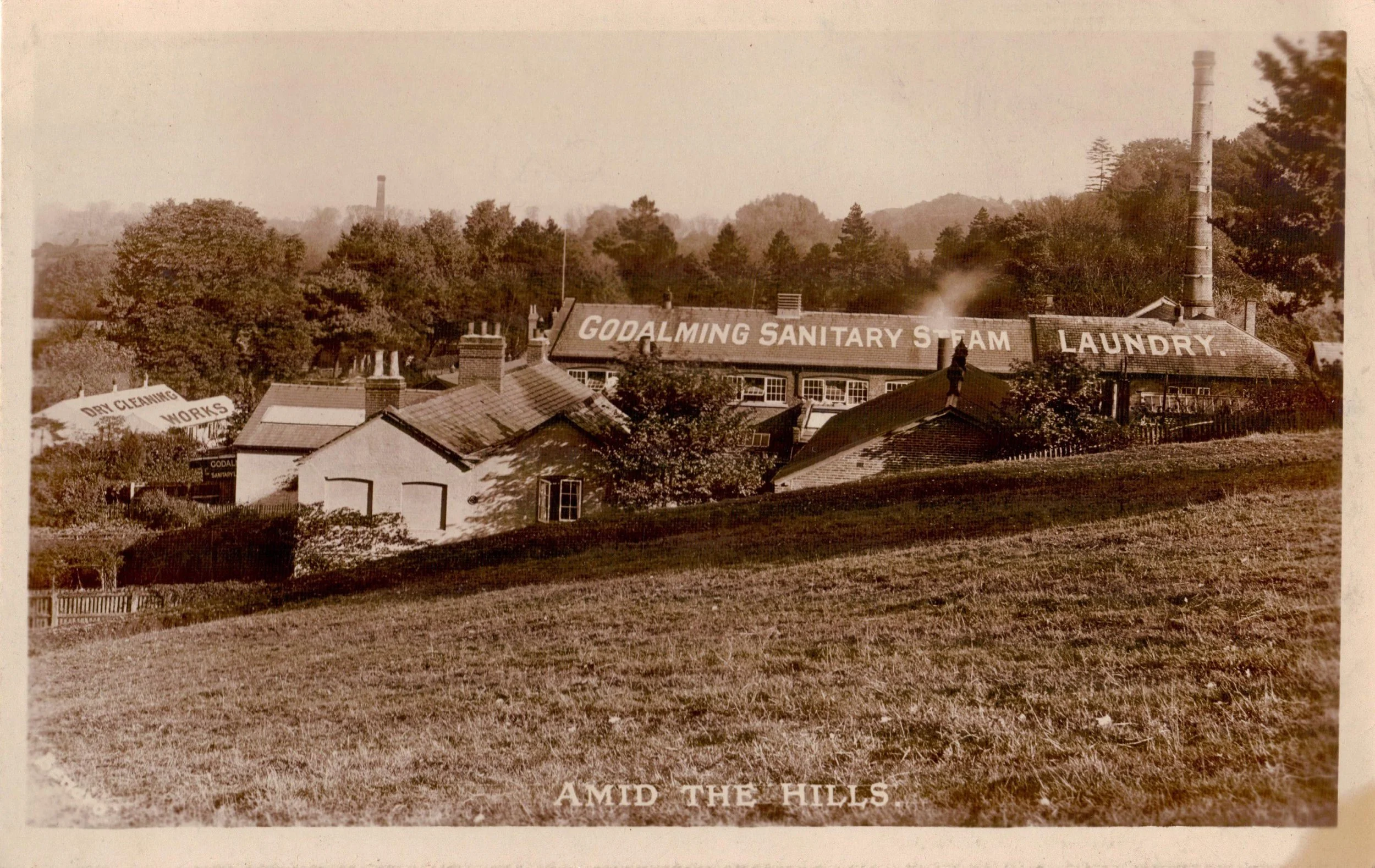
Black and white photograph from Fred Ball showing the Godalming Sanitary Steam Laundry.