Local History Articles
Our local history articles are the best place to find more detailed information on our collections, hear about current research, and find out more about the people and histories of Godalming.
We try to update our local history articles regularly but if you’d like to suggest a topic (or even offer to write a piece yourself) please get in touch! E: museum.curator@godalming-tc.gov.uk.
Our Latest Articles
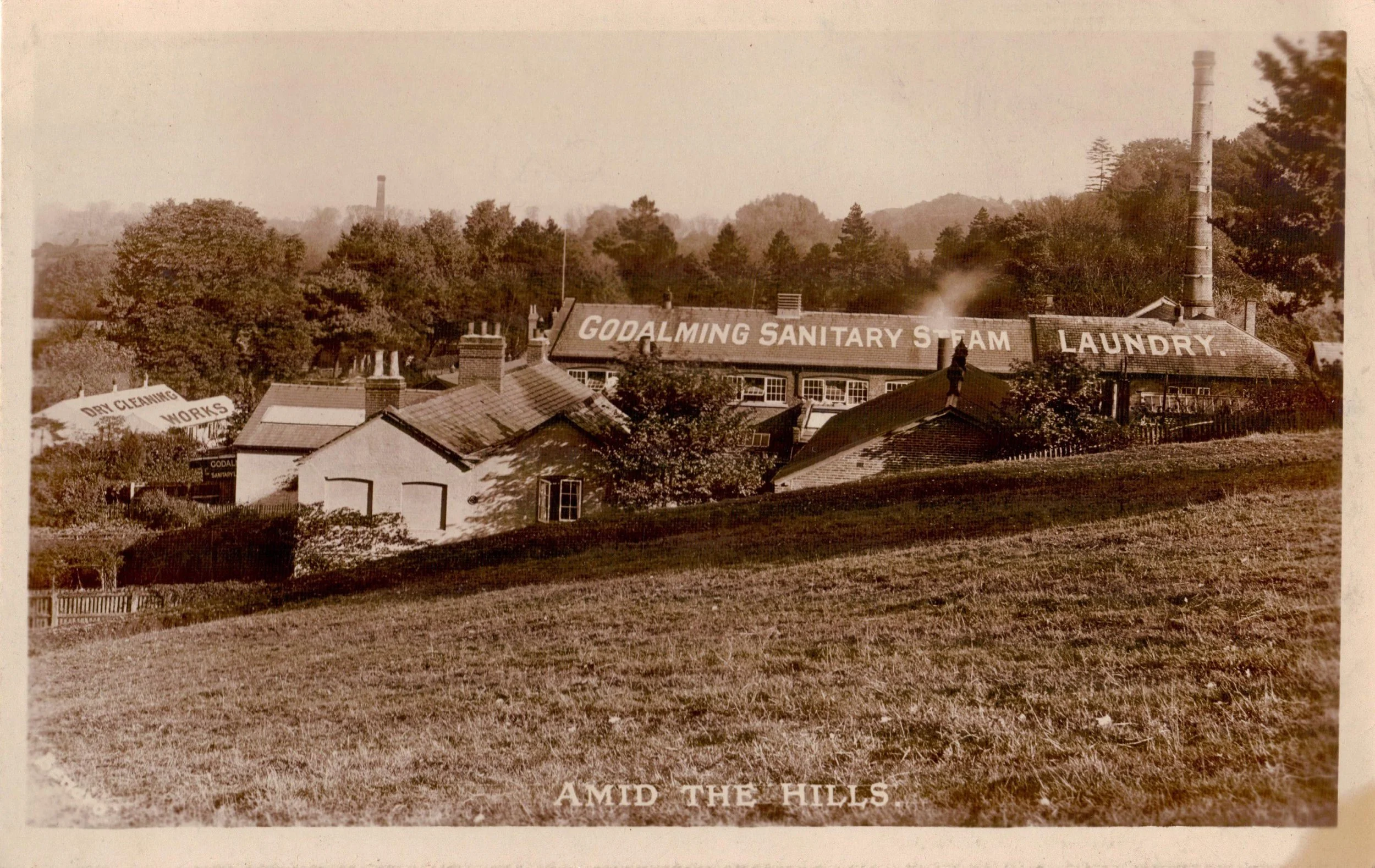


Victorian Catteshall, 1837-1901
Catteshall Lane has several important industrial sites, most of them pre-dating but still operating in, Victorian times. At the town end was the Godalming Wharf, where the barges on the Navigation loaded and unloaded and goods were stored. The Wey had been made navigable from Guildford to the Town Bridge in Godalming in 1764. At first the main cargo was timber, brought in by road to Godalming from the forests of Surrey, Sussex and Hampshire and carried downstream to the London shipyards. Gunpowder was also carried on the Navigation. It was brought by waggon from the mills at Chilworth and loaded onto barges at Stonebridge Wharf at Shalford.

Victorian Busbridge - (Crown Pits, Brighton Road and Holloway Hill), 1837 - 1901
Busbridge got its name from the Kentish Bursebrugge/Bursebrigge family. They held land here in the 13th century and probably established the Busbridge Estate. Well into the 19th century, this was a rural area - a country estate centred on Busbridge Hall, one of the local great houses (built in 1650 and enlarged in 1775). Highdown and Munstead were lonely heathland, crossed by packhorse tracks used by smugglers, who were said to come into the town down Holloway Hill.

Godalming Navigation
The existing Wey Navigation was authorised by an Act of Parliament in 1760 to extend up to Godalming (Godalming Navigation Act). This was to be an extra four and a half miles from Guildford Wharf to Godalming Wharf, and one and a half miles was to be new and man made, with a canal of four locks, and a fall of 32 ft. Locks were at Millmead, St Catherine’s, Unstead and Catteshall.

Edwin Landseer Lutyens (1869-1944)
Edwin Landseer Lutyens (1869-1944) was born on the 29th March 1869 in South Kensington, and was one of ten children and the ninth boy in a family of thirteen.
In 1885, when nearly sixteen, Lutyens went to the South Kensington School of Art to study architecture. He did not finish the course and started work under Sir Ernest George and Harold Peto in 1887, and went on sketching tours with Sir Herbert Baker, who became a life-long friend. Although without professional experience, Lutyens set up in practice on his own.
He met Gertrude Jekyll in the garden of Harry Mangles of Littleworth Cross, Seale, in 1889. They developed a friendship with over 100 plans, Lutyens designing the houses and Jekyll the gardens. Lutyens designed Jekyll’s potting sheds and garden outbuildings, known as The Quadrangle (1891). His first house designed for Jekyll, Munstead Wood Hut (1894) was for her to live in while Jekyll was waiting for her ultimate house, Munstead Wood (1896-7) to be built. Jekyll liked to watch thunderstorms and Lutyens designed the Thunder House (1895) in her orchard. Munstead Orchard (1898) was designed by Lutyens for Jekyll’s Swiss gardener. In Busbridge church yard is the family tomb he designed for Jekyll.

George Chennell and William Chalcraft: Murderers!
On Tuesday, November 11th 1817, about 7.30 in the morning, Mr. George Chennell, a shoemaker in High Street, Godalming and Elizabeth Wilson, his housekeeper, were discovered to have been brutally murdered.
Suspicion fell on George Chennell, the old man's son, and William Chalcraft, the carman. At the Surrey Assizes at Guildford on Wednesday, August 12th 1818, the trial of Chennell and Chalcraft for the above murder took place before the Judge (Mr. Sergeant Lens) and 12 jurymen.

The Pepperpot: a short history
Find out more about Godalming’s iconic Pepperpot (Market Hall) from the middle ages through to today.

James Edward Oglethorpe (1696-1785)
General James Oglethorpe (1696-1754) was the founder of the North American state of Georgia. He was immortalised in Pope’s famous couplet: “One driven by strong benevolence of soul shall fly like Oglethorpe from pole to pole.” Born in 1696 the youngest of ten children, Oglethorpe in 1718 inherited from his father, Sir Theophilus Oglethorpe, the family home Westbrook Place (now The Meath, a residential home for people with epilepsy). The Oglethorpe family originally came from Yorkshire.

A Short History of Godalming
This short article gives a taste of the parts of Godalming’s history that make it so special!

ClassAction by Godalming College
During the summer a group of students from Godalming College came to the museum to gain inspiration for performances developed as part of their Performing Arts Diploma.
They were charged with creating a piece of solo theatre (10 minutes) that responds 'to their local museum' that will excite and entice visitors into the museum.
The resulting pieces are creative and innovative performances that give a different perspective on our collections and Godalming’s history.

Percy Woods (1842-1922)
Anybody interested in finding out about the history of a place or family in West Surrey has reason to be very grateful to Percy Woods. A senior civil servant, Woods was from a family which had lived in Godalming for at least three hundred years, and his main leisure activity in his long life was research into the history of his area. He died in 1922, having sought out and written down details of deeds, wills, court cases and parish records relating to every town and village of the ‘Godalming Hundred’, an area stretching as far as Cranleigh and Haslemere. The notes and transcriptions, in his meticulous handwriting, run to more than 18,000 pages, now bound into 59 huge volumes, which can be consulted in the Museum Library.

Mary Tofts (1703-1763)
Mary Toft or Tofts (1703-1763), became well-known as the lady who gave birth to rabbits. In 1726 she became the centre of controversy when she deceived and hoaxed doctors into believing she had given birth to rabbits.

Witley Camps in the First World War
In Godalming Museum there is a display of broken china, worn toothbrushes and empty inkpots which I find particularly moving. These items were excavated from the site of the First World War army camps on Witley Common and are poignant reminders of the everyday lives of the men who were based there.

Gertrude Jekyll (1843-1932)
In 1848, the Jekyll family (Gertrude was the fifth of seven children) came to Bramley where they lived for 20 years. She was a multi-talented and creative woman who supported women’s suffrage, was an accomplished painter, craftswoman and garden designer. This blog post gives an insight into her life, and the items relating to her in the Museum’s collections.

Godalming & Electricity
In 1881, Godalming had electric street lighting and public electricity in people’s houses. It was not the first place to have electric street lighting but it was the first place in the world to have public electricity.

John George (Jack) Phillips, 1887-1912, Chief Wireless Telegraphist on the Titanic
Jack was appointed Chief Wireless Telegraphist on the new, “unsinkable” luxury Titanic, with Harold Bride as his junior operator. The wireless equipment on board was the most modern and most powerful of any merchant ship then afloat. It had a range of 250-400 miles in daytime and at night, when conditions for transmitting and receiving were more favourable, it occasionally spanned 2,000 miles. It is recorded that Jack had confided in a friend that while he was proud to be chosen to serve on the Titanic he would have preferred a smaller vessel. Jack expressed a dread of icebergs.