Victorian Busbridge - (Crown Pits, Brighton Road and Holloway Hill), 1837 - 1901
Busbridge got its name from the Kentish Bursebrugge/Bursebrigge family. They held land here in the 13th century and probably established the Busbridge Estate. Well into the 19th century, this was a rural area - a country estate centred on Busbridge Hall, one of the local great houses (built in 1650 and enlarged in 1775). Highdown and Munstead were lonely heathland, crossed by packhorse tracks used by smugglers, who were said to come into the town down Holloway Hill.
In 1854 Ellis Gosling inherited Busbridge Hall and Estate. He died in 1861, just weeks before the birth of his son, Ellis Duncombe Gosling, but his wife, Emma, remained at the Hall until 1889 and greatly influenced the development of the area over the 19th century. She married again – Captain John Charles Francis Ramsden of Oxton Hall, Yorkshire - and it was as Emma Ramsden that in 1867 she built St John’s Church, in memory of her first husband. The Ramsdens also founded the school, which opened in 1868.

Photograph of an invitation card. Mr Jones was invited to commemorate the coming of age of Ellis Duncombe Gosling, February 27th 1882. The card features a print of Busbridge Hall.
The below 1871 map shows Crownpits (which appears as Crumpetts in a document of 1808) as a small settlement surrounded by fields. There are sand pits at Crownpits and Bargate stone quarries on Holloway Hill. The roads – Shackstead Lane, Holloway Hill, Busbridge Lane and Brighton Road are country lanes passing through farmland. Holloway Hill House had been built in 1839 by Mr Mellersh (of the Godalming Bank). The position of the Church and School reflect their dependence on Busbridge Hall to the South.

Ordnance Survey Map XXX1 15, dated 1871, showing Crownpits
Writing in the 1920s, The Revd. Henry Larner described Busbridge in the 1870s. “Sunday was the day of rest and every thing peaceful in the village; most all the men went to morning service, and the women in the afternoon, the police constable always attended in his uniform. There was a little bustle at one o’clock when the dinners were fetched, covered with a snow-white cloth, from the bake house where they had been capitally cooked for one penny. On Harvest Thanksgiving Sunday the Busbridge drum and fife band played through the village to the Church with the big drum decorated with fruit and corn of which a great quantity was grown in those days. On the Saturday the Harvest Home used to be held at Busbridge Hall and one year as many as a hundred men sat down to dinner in the old barn. At Easter the school children would gather and bunch primroses for the church, taking them to the Rectory on Saturday morning, for which they all received threepence. A summer treat was often given down at the old Hall, other years in the Rectory meadow. One year some of the big girls were taken by the Sunday School teachers to the Crystal Palace. Such a treat was then thought most wonderful. At this time there was only one farmhouse on Holloway Hill, it was all fields, footpaths and stiles.”

Mounted black and white photograph of interior of Church of St John the Baptist, Busbridge, looking east from the west end of the aisle, pre the 1910 alterations.
The school logbooks reveal a less idyllic picture. Maureen Nyazai, in her history of Busbridge School, writes of the “damp, poorly lit, unheated, unsanitary homes, sparse unvaried diet – bread and dripping, the monotony of daily life which for so many adults was alleviated by drink (this then becoming another problem); the poor clothing, especially that of the children who wore ‘hand-me-downs’ most of the time, often did not have underclothes, boots or substantial outer clothing and in winter times were sewn into their clothes until spring, thus preventing even the most basic hygiene; and finally the rural isolation suffered by those who lived in villages near or on big estates like the Busbridge Estate. Such conditions persisted in Busbridge right up to World War II and contributed significantly to the general ill-health of the population. Diptheria, whooping cough, measles, mumps, scarlet fever, croup, lice, coughs and colds were common-place and frequently caused so much disruption in the village that the school was closed for long periods of time and infant mortality was a common occurence.” Children were taken out of school to help with work on the estate, particularly at harvest time or to beat for shoots. There was ill feeling between the children who came from the rural area to the south of the school and those from the increasingly built up area between the school and Godalming.

Photograph taken by Mr Hodgson, the headmaster, of a classroom in Busbridge School in 1921.
Arts and Crafts garden designer Gertrude Jekyll moved to Munstead in 1877 and 20 years later commissioned, Munstead Wood, from Sir Edwin Lutyens. The Busbridge Parish Magazine dated ‘Midsummer 1890’, has a notice headed ‘Garden Seeds’. ‘Miss Jekyll has again prepared packets of seeds for any of the parishioners of Busbridge who take an interest in beautifying their gardens’
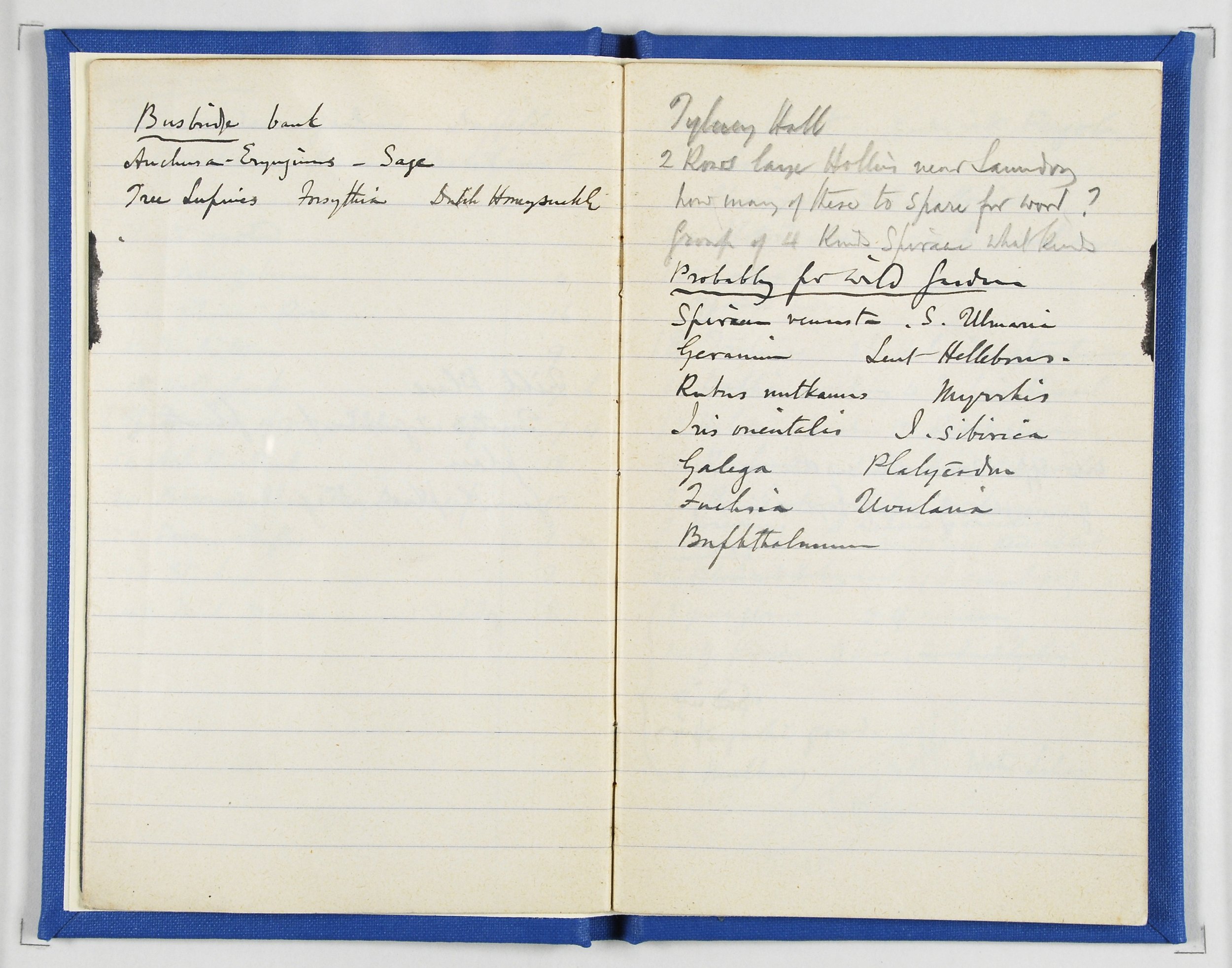
Gertrude Jekyll's plant lists for the gardens she laid out at Busbridge Park, Godalming, Surrey (1904)
The below 1895 map shows buildings extending up Brighton Road, Holloway Hill and Shackstead Lane. Summerhouse Road, Ramsden Road and Oak Dene Road have been laid out and the land split up into generous building plots. The old field paths have survived (and survive still, though densely hemmed in by houses). The 1901 census describes many of the residents of this area as “living on own means”; others were retired from the army or civil service, or professional men working in businesses in the town, like Mr Fisher, the Managing Director of the Leather mill in Mill Lane, who lived in Oak Dene Road. One of the buildings on Brighton Road was the Busbridge Institute, which opened in 1885. You can see the recreation ground, where the town celebrated Queen Victoria’s Diamond Jubilee in 1897, with its lodge and the Cricket Pavillion built by the Ramsdens in 1878. Crownpits is linked to the town by Townend Street, Carlos Road and Latimer Road.

Ordnance Survey Map XXXI 15, dated 1897, showing the Busbridge area.
Local historian Charles Softley (1829 – 1916) described the changes he had seen in this area over his lifetime. “The first [change] to be noted is that of Holloway Hill and part of the Busbridge Estate. The only building was the old Farm House occupied by one Parrott on behalf of Mr T Elwin. The first residence was that of Mr F Mellersh who built it in 1839, where he died and where most of his family was born. I believe the property was not included in the Busbridge Estate. Then followed the buildings on the latter estate as now shewn, with the Recreation Ground. Town End Street and Latimer Road are on the site of two meadows, and an orchard of Mr Stilwell, and built in about 1880. Brighton Road villas were built just after the Skinner’s Hall in the High Street, in about 1838. Our next change is at the bottom of Holloway Hill. The two cottages under the hill on the left and built by Mr Mellersh on a plot of land where a theatre or circus would often appear. This spot was also used by John White where he would break in his young horses. Next, the buildings at the bottom of Rock Place are erected on ground which Mr Ford used for the Carpentary, reaching from the Baker’s Shop to the terrace, beyond which is Fir Grove. These villas were erected by Mr G Marshall in 1853. It was then Meadowland.”

Mounted engraving, 'Godalming from Rock Place', published by Rock and Co, London, No2529, 19th August 1854