Godalming Navigation
The existing Wey Navigation was authorised by an Act of Parliament in 1760 to extend up to Godalming (Godalming Navigation Act). This was to be an extra four and a half miles from Guildford Wharf to Godalming Wharf, and one and a half miles was to be new and man made, with a canal of four locks, and a fall of 32 ft. Locks were at Millmead, St Catherine’s, Unstead and Catteshall. The locks were built to pass a craft measuring 73ft 6 inch in length, and with a 13ft 10inch beam. On the 26th April at a cost of £6,450, the Godalming Navigation opened for traffic. Deeds of conveyance of land and meadows had had to be arranged and it appears that the work was being carried out in 1762 but that it was completed not later than 1767.

Map of the River Wey by Stedman, 1757, showing the plan to make the River Wey navigable. Names of the owners of land affected are shown, and a few buildings are illustrated, including ' Mr Austen's ' and ' Deanery Barn '
The Godalming Navigation was a separate business from that of the Wey Navigation. Commissioners, who were local landowners such as Edward Garthwaite of Hall Place in Shackleford controlled the navigation. The Commissioners were entitled under the Godalming Navigation Act of 1760 to issue assignments of shares in the tolls at interest not exceeding 5 per cent per annum. Two subscriptions were issued in 1760 and 1763 for a total of £7,800. Local subscribers included Tho. Chandler of Hambledon, Geo. Chitty of Godalming, a butcher, and John Bridger of Milford, a blacksmith. The Commissioners made resolutions concerning the wharfage charges as in 1779 for timber, ‘grocery, shop-goods, white rags etc’, and regulations for the carriage of timber.

Make it stand out
Printed paper handbill, fixed to card, 'The Commissioners for Extending the Navigation of the River Wey...' announcement of the opening of the River Wey Canal, 29th May, 1764, with a scale of charges. Printed by Charles Martin at the Angel and Bible, Guildford
In 1810 it took three to four days to navigate the 50 miles between London and Godalming with horses pulling the barges. The average price of carriage which included the tolls, was for valuable goods, perishable goods, and those liable to risk 2½d to 3d per ton, per mile, and other goods, coarse or heavy from 2d to 2½d per ton per mile.
In 1813 an Act for making and maintaining a navigable canal to unite the rivers Wey and Arun in the Counties of Surrey and Sussex was passed. In 1816 the Wey and Arun Junction Canal entering the Godalming Navigation at ‘Guns Mouth’ at Shalford was opened. ‘Guns Mouth’ was the name given after the gunpowder from the Chilworth factory that was loaded from wharves at Shalford. Gunpowder was loaded from Shalford and Godalming to go to Guildford and beyond. The maximum amount to be carried in craft through London was 25 tons and six barges were often loaded per month. The movement of gunpowder was not without its problems. In 1864 two people were killed in an explosion of a barge carrying powder on the Godalming Navigation.
In 1825 there were two barge-owners in Godalming. Messrs. Charles and Richard who owned the Unity, Industry and Providence, and Mr George Marshall who owned London, Hope, Royal Oak and Triumph. The barges, upward bound from London to Godalming were mainly for wool and imported timber; and those for downward bound from Godalming were usually English timber and hoops for making casks and barrels. In the mid 1840s the Stevens family managed both the Wey and Godalming Navigations. George Marshall was a timber merchant of Godalming and the Marshall family accumulated all the share assignments between 1834-66.

Photographic print of postcard showing Bridge House, Godalming, for long occupied by the Marshall family. George Marshall was a timber and coal merchant who had his yard close by the Wharf.
The Wey and Arun Junction Canal was closed in 1871. In the early 1900s it was only small craft with river sand that unloaded at Godalming Wharf, but in 1909 barge traffic was restarted. The Great War of 1914-1918 closed the Chilworth gunpowder works, and only a few freights of round timber were loaded at Godalming Wharf towards the end of the war. The last cargo of timber was in 1925. From 1939-1946 coal was brought up from London to the Vulcanised Fibre Works at Shalford, but this ceased when they changed over to oil fuel. The railway coming in 1849 to Godalming also affected barge traffic and trade. The Surrey Advertiser in 1895 recorded that some gentleman had combined to purchase boats for hire, although the canal was used before for pleasure boating. The Farncombe Boat House at Catteshall Lock lets out boats for use on the canal.
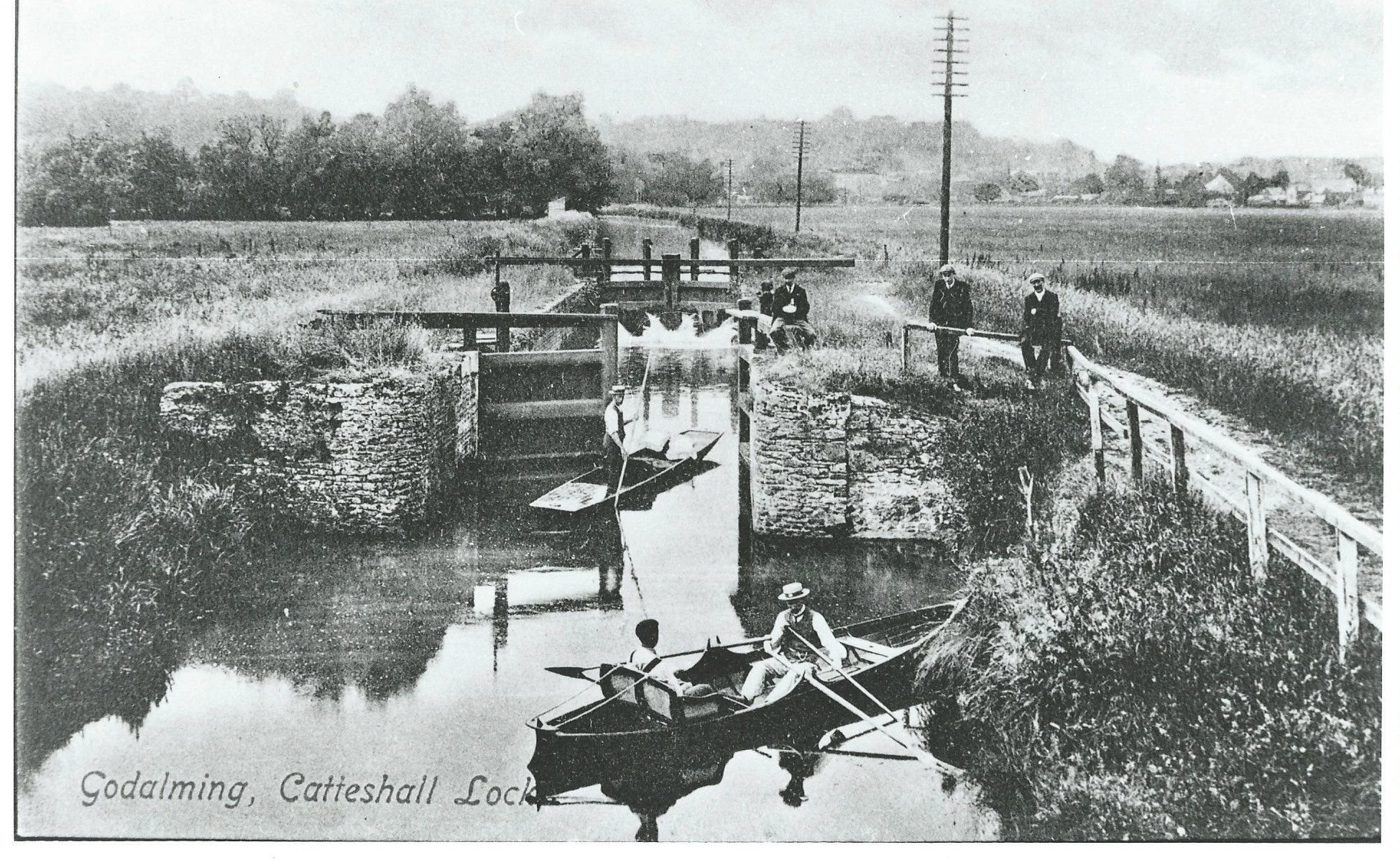
Black & white postcard showing Catteshall Lock
The Stevens family had control of the Wey and Godalming Navigation for over a century and in November of 1963 handed over the Wey Navigation to the National Trust. In 1964 a newspaper report shows that the Guildford Town Council’s General Purpose Committee signified their assent to the transfer of the Godalming Navigation of the River Wey to the National Trust. It was only Guildford Council that had the power to take over the Navigation, which they did and immediately transferred to the Trust. The town bridge at Godalming is the head of the Godalming Navigation and of the National Trust Property.
The largest number of boats to be seen at Godalming was the London and Home Counties Branch of the Inland Waterways’ Association ‘Rally of Crafts’ at Whitsun of 1964 when 120 boats of all shapes and descriptions were welcomed.